4183106860_11590f85a6_o

Collapse Total: New Tactics and Strategies for the Climate Justice Movement

Editor’s note: From the 15th to the 22th of November, in different countries, the Glasgow Agreement is articulating mobilizations, protests and blocks against one of the biggest oil & gas companies in the world: Total. This story first appeared in Common Dreams. By João Camargo The social alliance to take on global capitalism must be global, radical, popular, tactically, and strategically focused, while at the same time flexible and imaginative. Is climate collapse close to being averted? How close are we to winning? Is the climate justice movement organized to win? Are current strategies and tactics enough? What else do we need to try and how fast? The Glasgow Agreement, People’s Climate Commitment, is a global platform of grassroots and social movements for climate justice. It is planning on going after French multinational Total simultaneously all around the world this November, in an action called Collapse Total, and organising climate justice caravans in all continents next Spring. ...

November 12, 2021 · 6 min · roger
visuals-b9wsEM40Cv0-unsplash

Revolutionary and anti-capitalist strategy

This article originally appeared in Building a Revolutionary Movement By Adam H This post looks at if it’s possible to have a coherent strategy for the emancipatory transformation of a complex social system, 5 anti-capitalist strategies and revolutionary strategy. What does ‘emancipatory transformation of a complex social system’ mean? We currently live in a capitalist society or capitalist social system that is not equal, just, democratic or sustainable. Emancipatory means the struggle for political, economic or social rights or equality for disenfranchised groups or sections of society. So this post is focused on thinking about how we think about the route to ending the dominance of capitalism so we live in an alternative society that is equal, just, democratic and sustainable. ...

October 19, 2021 · 17 min · roger
20140524-165854-Edit

The Moral Argument for Ecological Revolution

Written and photographed by Max Wilbert In 1941, as World War II thundered across half the planet, my grandfather was drafted into the United States military. Faced with the prospect of being sent overseas to kill other young men in World War II, his morality rebelled. He refused to join the military and applied for conscientious objector status, which he was eventually granted. This was not a popular stand to take. Among 10 million draftees, about 43,000, or less than half of one percent, became COs. He and other COs were widely criticized, attacked, and ostracized. Their beliefs were tested by draft boards, families, and communities who rejected their moral convictions and labeled them cowards, deserters, and traitors. ...

November 18, 2019 · 22 min · greatbasin
dan-meyers-p4dLYHuuI-U-unsplashsmall

Why has environmental activism been ineffective?

by Liam Campbell Humanity has a long history of environmental activism, likely extending far beyond the reaches of recorded history. It’s easy to imagine warring tribes of indigenous peoples struggling against exploitative and excessively greedy neighbours. Competing tribes probably used violence to prevent each other from overconsuming fisheries, harvestable plants, and driving game to extinction. These actions maintained equilibrium within the broader ecosystem and allowed the indigenous humans to survive indefinitely. Fulfilling these obligations to nature would not have been easy; people would have experienced more frequent hunger, higher rates of mortality, and for frequent incidents of violence. Most of these cultures had warrior classes whose obligations often included ritualised violence against competing groups, though rarely did conflict escalate into total war. ...

September 26, 2019 · 7 min · rcamp
RUBBER

Rubber: The Achilles Heel of Industrialization

Editor’s note: large sections of this article are inspired by Without Rubber, the Machines Stop by Stop Fossil Fuels. Deep Green Resistance does not endorse their organization or their analysis but it’s worth reading. by Liam Campbell It’s easy to take rubber for granted. Without it, most of the world’s vehicles would literally grind to a halt, airplanes would eventually be grounded, and most of the world’s industrial factories would cease to be profitable. When someone mentions rubber people think of tires, but open up a car and you’ll find a staggering number of components require the substance: seals, hoses, shock absorbers, wiring, and interiors. If you swim farther down the supply chain you’ll discover that the manufacturing factories that create vehicles also need vast quantities of rubber to operate their own machinery; the same is true of the processing plants that refine raw materials for the factories, and so on all the way down the supply chain. ...

July 25, 2019 · 4 min · rcamp
Res

Protective Use of Force: Self-Defence and Counter-Violence, Part Two

This is the twenty-second installment in a multi-part series. Browse the Protective Use of Force index to read more. via Deep Green Resistance UK In Part One ( read here), I explored the importance of viewing our resistance as acts of self defence and counter violence. I also discussed the two main arguments against using force, and that the moral question needs to be reframed. The decision about what strategy and tactics to use depends on the circumstances, rather than being wedded to one approach out of a vague ethical dogma.Peter Gelderloos, an anarchist writer, reframes the question of if tactics are violent or not, by asking if the tactics are liberating when we are meant to be obedient consumers. Does the action result in space being reclaimed and held. Examples of this are the Spanish Civil War, Greece uprising of 2008, the Oaxacan state resistance to the Mexican government in 2006, and Hamburg 1986/7. [1]If those fighting for a better world are going to be successful, then we all need to resist in the ways that make sense to each individual or group, and play to their strengths. At the same time, activists need to respect others ways of resisting, and work out how all these different methods can strengthen each other to build a movement. This approach is known as “Diversity of Tactics,” or more recently “Full Spectrum Resistance” or a “Holistic Resistance Movement.” [2] Gelderloos describes how nonviolence fundamentalists view a social conflict as a chessboard where the movement’s leaders try to see or control all the pieces. The diversity of tactics perspective sees it is as a vast, opaque space with countless actors, whose needs are not always compatible as the struggle shifts. This involves agreeing zones for different tactics to be employed so tens of thousands of people can surround a summit and blockade; or disrupt with a combination of peaceful marches, sit-ins, lock-ons, tripods, barricades, riots in nearby business districts to draw of police, and then fight with them in the streets. [3]Gelderloos explains that approach has been successful, but it requires all the groups with different tactics to work together. [4] It also requires the protest to not be centrally controlled, and that there be no central focus to the event, but many individuals and groups resisting as they see fit. [5] A recent example is the 2012 Barcelona uprising following a general strike, where several thousand people held space and some fought with the police and temporarily liberated space. [6] However, employing a diversity of tactics approach as part of a nonviolent mass movement campaign can be counterproductive if the campaign needs nonviolence discipline to be successful. If the aim of the nonviolence campaign is create a dilemma for the authorities or to get them to overreact then it is very important that nonviolence discipline is maintained. This is a very different strategy to the idea of holding space. Both have an important part to place in our resistance depending on the circumstances. There are a number of different forms of direct action, with varying effectiveness through history. When different types of protest and direct action are combined they can make the overall movement for change more effective by opening avenues of resistance that are not easily co-opted or controlled by the state. Those that fail to see the importance of supporting all of the direct action tactics available, weaken the movement. To quote Ann Hansen from the Canadian militant group Direct Action: “Instead of forming a unified front, some activists see the sabotage of destructive property by protesters as being on the same level as the violence of the state and corporations. This equation is no more accurate than saying that the peace of a concentration camp is the same kind of peace that one finds in a healthy society. If we accept that all violence is the same, then we have agreed to limit our resistance to whatever the state and corporations find acceptable. We have become pacified. Remaining passive in the face of today’s global human and environmental destruction will create deeper scars than those resulting from the mistakes we will inevitably make by taking action.” [7]Nonviolence advocates such as Marty Branagan generally don’t support the use of diversity of tactics, and some argue that the use of force by some discredits everyone at an action. In their view, if the majority of a group has decided to use nonviolent methods, then why “should they be forced to allow violent tactics to taint their protest?” [8] Gelderloos respects those whose concept of revolution is to work for peace and follow a philosophy of doing no harm. He argues that the basis of respect is recognising the autonomy of others, and allowing and supporting them to fight for freedom in their own way. It’s appropriate to criticise those we respect, but not to try to make them become more like us: “the purpose of that criticism is to learn collectively at the point of conflict between our differences, not to turn them into Black Bloc anarchists.” [9]. He believes that we are all suited to different tasks, based on our temperament, abilities, experience and ideas about revolution. All of them are necessary; it’s a disservice to revolutionary principles to rank some of them over others. Glorifying illegal and combative tactics would create the same dynamic in which nonviolence fundamentalists create by only considering nonviolent methods. [10]The legitimacy of nonviolent fundamentalists’ ideology must be constantly reviewed and assessed to determine if it is capable of achieving the social change it promises. Its lack of success does not mean abandoning all forms of nonviolent struggle, and only pursuing armed struggle. Instead we need to consider and develop the broadest possible range of thinking and action to resist the state. Rather than view different forms of resistance as separate components, they should be viewed as a continuum of activity from petitions, to demonstrations and protests, to the use of force in self defence. [11]Jeriah Bowser offers a framework for resistance that includes both violent and nonviolent tactics. It offers a four-stage path for individuals from a disengaged pacifist to an engaged, empowered, and dedicated view of resistance towards oppression. ...

May 6, 2017 · 9 min · michael

Protective Use of Force: Self-Defence and Counter-Violence, Part One

Featured image: RCMP in riot gear during raid on anti-fracking blockade, Mi’qmak territory, Oct 17, 2013. From Warrior Publications. This is the twenty-first installment in a multi-part series. Browse the Protective Use of Force index to read more. via Deep Green Resistance UK The destruction of our world isn’t an “environmental crisis,” nor a “climate crisis.” It’s a war waged by industrial civilisaton and capitalism against life on earth–all life–and we need a resistance movement with that analysis to respond.I spent years as a liberal environmentalist, believing the propaganda from the state and the mainstream environmental movement that change will come about through top down solutions and technology fixes. Well, look where that’s got us – increasing destruction of the biosphere, accelerating species extinction and repeated failures of climate negotiations that are sold as successes. When I finally understood that this approach wasn’t going to work, I got involved with the UK climate movement, but was unconvinced of their strategy and tactics. I respected the work being done but it looked hopeless considering the scale of the problems and the system causing them. In 2012, I read the Deep Green Resistance book. The book proposed a resistance movement forcing a crash of industrial civilisation and ending ecocide that made far more sense to me than anything else being offered. A strategy that is appropriate to the scale of the problem. I see this response as self defence, or counter-violence. What is counter-violence? Frantz Fanon in The Wretched of the Earth coined the term to mean the violent, proportional response by colonised people to the coloniser’s violent repression. It has since been used more generally to refer to by any group’s use of force in response to state violence. [1]Other terms for this response might be ”protective use of force,” “holistic self-defence” [2] or “defensive violence.” I find these ideas a relevant and useful way to frame how to respond to the destruction being inflicted on our world by industrial civilisation. Self-defence actually discourages aggression and is a much better principle to use as a starting point than nonviolence. The definition of self-defence, agreed after thousands of years of experimentation, is that you can use the necessary amount of force to end an attack. Self-defence is a right and duty; a community that does not defend itself against aggression encourages further aggression. If aggressors are willing to kill or hurt anyone who gets in their way when taking what they want, there is little that those that practice nonviolence can do.Most resistance movements in history have resorted to the use of force in response to the violence directed against them. They are simply defending themselves against violence by governments or the state. Mike Ryan articulates this well: “We accept the necessity of armed struggle in the Third World because the level of oppression leaves people with no other reasonable option. We recognize that the actions of Third World revolutionaries are not aggressive acts of violence, but a last line of defense and the only option for liberation in a situation of totally violent oppression.” [3]So if freedom fighters in less industrialised countries are considered justified by many in using force against oppression, then why not in the industrialised world? Why not sabotage industrial infrastructure, if it amounts to self-defence? Perhaps because our conditioning to not act is too strong–we are too comfortable and have too much to lose. And therefore our collective inaction admits our participation in the oppression of other people.When thinking about self-defence, we first need to be clear on what we mean by violence: Is fracking, deforestation, the damming of rivers, factory farming and the trawling of oceans violence? We also need to ask if non-humans who use force to protect their habitat, pack or family are violent? Your answers to this questions will affect if you think humans acting in self defence of their home or people are justified. [4] Self-defence is a right we must reserve for ourselves. It we do not, then we invite violence attacks on ourselves, our families and our communities. Self-defence is the only thing that keeps violent institutions in check. It must also be combined with genuine solidarity with all non-human and humans under attack.Assata Shakur, founding member of the Black Liberation Army and former Black Panther, clearly understood the need to fight back against the FBI and police who were killing black liberation leaders and activists. [5] Following the shooting of two New York police officers she said: “I felt sorry for their families, sorry for their children, but I was relieved to see that somebody else besides black folks and Puerto Ricans and Chicanos were being shot at.” [6] The US communist Angela Davis describes how any revolutionary movement focuses on the principles and goals it is aiming to achieve, not the way they are reached. She described how society’s systemic or structural violence is on the surface everywhere, so is going to lead to violent events. The former Black Panther Kathleen Neal Cleaver describes how the systematic violence against people of colour in the form of bad housing, unemployment, rotten education, unfair treatment in the courts–as well as direct violence from the police–led to the Black Panther Party forming to defend themselves.I feel a deep sadness for what is happening to living beings and the natural world. I have been so well trained and conditioned by this culture that I struggle to really feel angry about what is happening. I think feeling angry is the appropriate response. We need to stop being so polite and positive, and connect with our anger about the destruction that is taking place. People alive now will be measured by those that come after by the health of what’s left of their landbases. [7] What matters is being effective, not moral purity about using only nonviolent tactics. We need a new Three R’s; instead of Reduce, Reuse, Recycle, they should be Resist, Revolt, Rewild. [8] The two main arguments against using force or violence are that it is morally wrong and ineffective. The moral question needs to be reframed. Instead of judging if an act of force in an isolated situation is justified, we need to ask what actions are necessary to ensure the least amount of suffering to living beings overall. This means seeing ourselves as connected and as part of nature, and then acting in defence of life. To quote Mark Boyle: “We need to defend the Earth with the same ferocity we would evoke if it were our home, because it is. We need to defend its inhabitants with the same passion as if they were our family members, because they are. We need to defend our lands, communities and cultures as if our lives depended on it, because they do.” [9]There isn’t any one strategy or tactic that is necessarily more effective than another. It depends on the circumstances. Those that advocate the use of force certainly don’t argue that it’s a more effective tactic and that nonviolence should never be practiced. [10] To think that violence is not effective is deluded. Clearly violence is effective because that is what the state uses. Of course, the ends achieved through undesirable means may not themselves be desirable. Also most revolutionary and decolonisation struggles have involved nonviolent and counter-violence movements working in tandem. [11] ...
April 24, 2017 · 9 min · michael
animals

Protective Use of Force: Nonviolence and the Environmental Movement, Part Five

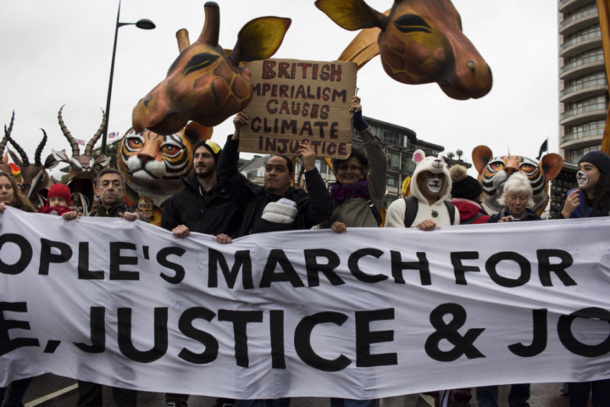
Featured image: animals steal the place of the Wretched of the Earth bloc at the People’s Climate March of Justice and Jobs. By Dominique Z Barron. This is the twentieth installment in a multi-part series. Browse the Protective Use of Force index to read more. via Deep Green Resistance UK In this run of five posts, I am assessing the environmental movement using the twelve principles of strategic nonviolence conflict as described by Peter Ackerman and Christopher Kruegler. [1] The principles are designed to address the major factors that contribute to the success or failure of nonviolent campaigns. Read more about the principles in the introductory post here . Read how the environmental movement relates to the first principle here, the second to fifth principles here and the sixth to the tenth here. ...

April 19, 2017 · 6 min · michael
719561-336059-14

Protective Use of Force: Nonviolence and the Environmental Movement, Part Four

This is the nineteenth installment in a multi-part series. Browse the Protective Use of Force index to read more. via Deep Green Resistance UK In this run of five posts, I am assessing the environmental movement using the twelve principles of strategic nonviolence conflict as described by Peter Ackerman and Christopher Kruegler. [1] The principles are designed to address the major factors that contribute to the success or failure of nonviolent campaigns. Read more about the principles in the introductory post here . Read how the environmental movement relates to the first principle here and the second to fifth principles here . ...

April 3, 2017 · 6 min · michael

Protective Use of Force: Nonviolence and the Environmental Movement, Part Three

This is the eighteenth installment in a multi-part series. Browse the Protective Use of Force index to read more. via Deep Green Resistance UK In this run of five posts, I am assessing the environmental movement using twelve principles of strategic nonviolence conflict. [1] The principles are designed to address the major factors that contribute to the success or failure of nonviolent campaigns. Read more about the principles in the introductory post here. Read how the environmental movement relates to the first principle here. ...

March 22, 2017 · 5 min · michael