
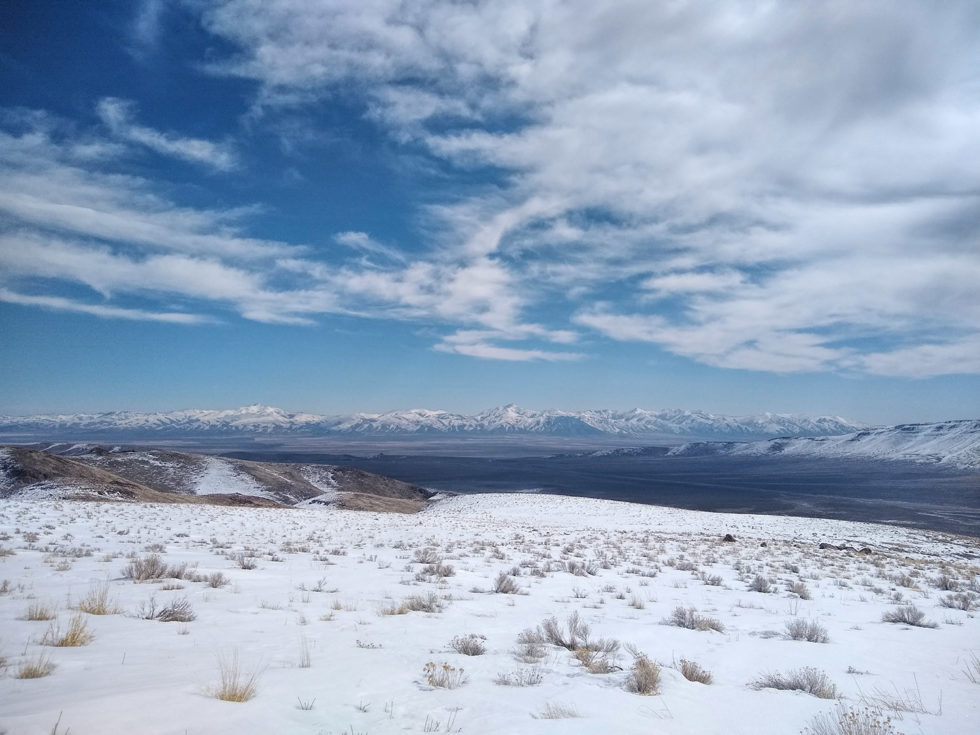
Upon the Proposed Mining of “Thacker Pass, Nevada”.
A poem by Sarah Gar, a visitor to the land of the Paiute and Shoshone people and the sagebrush creatures.
It’s quiet here.
And I’m not talking
about experimental silence,
American guru silence,
or any sleek human site
that seeks inner peace
(and other noise)
to drown out the drawing-down
and drying-up of every sacred thing.
I’m talking about silence
of lands beyond witness,
a silence embedded and embedding,
the one nestling in the nighthawk’s cries
and cradling these words.
Tall sagebrush touches it —
4 feet 33 millimeters
of branching space,
where voice and silence
play by listening,
weaving water and light
without worrying who
appears as what
before whom.
It’s as if nothing can be said
to arrive or leave in wild places.
Even our breath cannot be said
to enter this place
where it meets other selves
always here and already inside.
But when Grandmother comes,
wakes the fire with practiced taps,
the flames flare in reminder
of whose Spirits keep this place.
Even in “deserted” places
dry soil knows to gather
soft and firm around water,
forming delicate strata
to nourish roots
and catch the drifting seed.
We, too, know to gather,
asking if we are also this place,
and if so,
how we can return.
To get here
we must track ourselves
by species memory,
a long way back,
to when losing one’s way
first became possible.
We trace back to the end’s beginning,
when the volume had to rise,
to create an endless diversion,
to mask the pesky screams
of women and slaves.
Yes, we tracked ourselves,
even did a blood spatter analysis.
A few facts emerged to tell us:
- We are the losing and the lost.
- There’s nothing lonelier than empire, and nothing stranger than killing one’s beloved.
These facts cleared the room.
Even history couldn’t erase them.
The clock ticked.
Corporations continued to cut down the ancient ones.
And so we rose, rotating and revolving
pulled forward by the falling-apart feeling
which is love.
This must be love because,
as sung by Paiute and Shoshone,
danced by pronghorn and coyote,
this place would hold forever,
streams passing
through trouts’ gills,
sun glancing off scales
and into eagle’s eyes
as she watches over.
Past and future
would nest together,
quiet as grouse eggs,
speckled and constellating,
in tacit reference to each other.
Birth and death would spiral together,
strong and fragile as pyrg shell,
and we would learn again
to listen and to hold
this language,
the spinning of the silence
that found us first,
soft as jackrabbit,
buried as bones,
strong spines of sage
and mountain song.
As a former English professor from the East Coast, Sarah now focuses on writing and activism in the Pacific Northwest. Her poetry grieves patriarchal and colonial violence, summons reverence for the natural world, and upholds matriarchal cultures which cherish life.